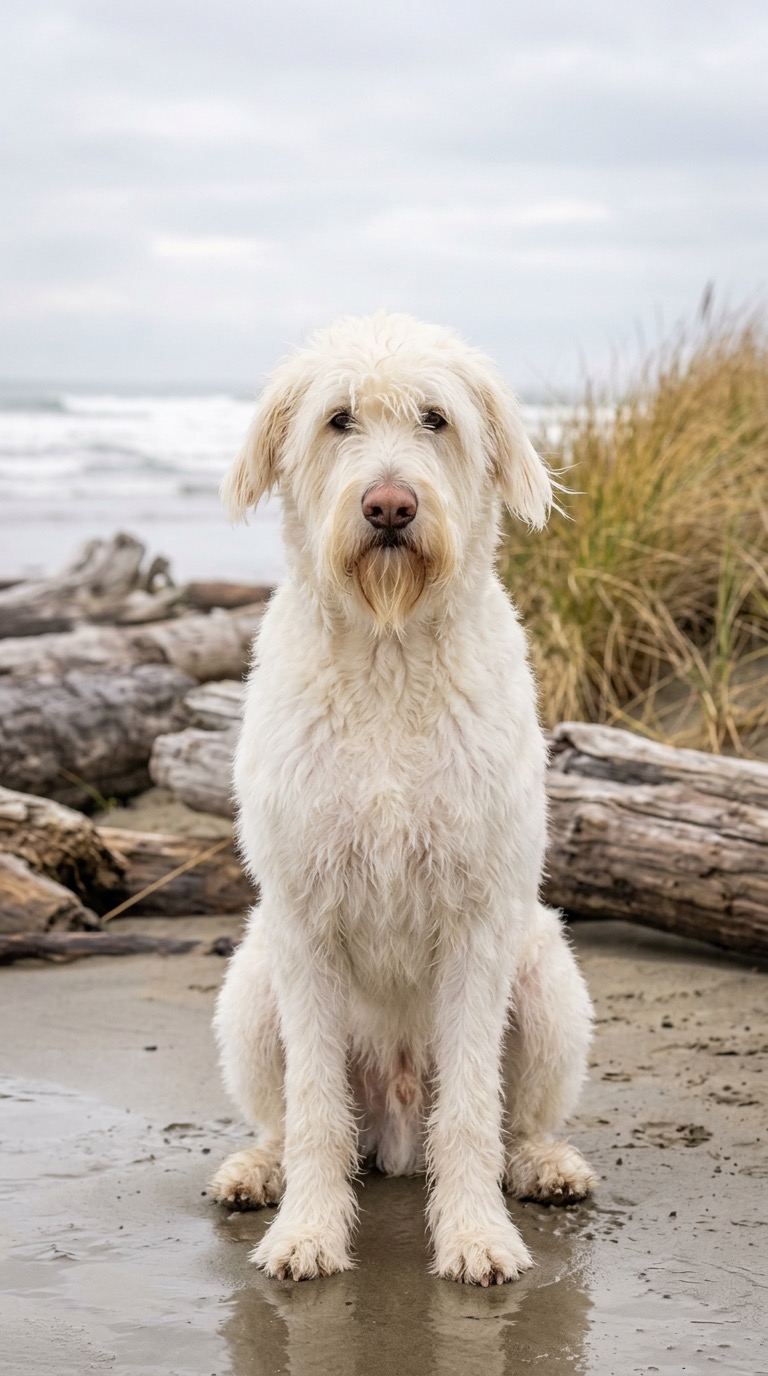
Every afternoon, two big dogs lie on our deck and watch the
corner of the street. They know the sound of my husband's car before I do. The
garage door goes up, and they're gone, a blur of white and wiry brown sprinting
inside. By the time we walk in, Todd is at the top of the stairs, bouncing. Not
wagging. Bouncing, straight up and down, like his legs are springs. Ellie is
across the room at the sliding glass door with a rope in her mouth, whining and
wiggling her whole back end.
This happens every single time we come home. Every time.
I'm telling you this first because it's the thing people
worry about most when they're thinking about getting a large dog while working
full-time: Will my dog be miserable while I'm gone? And the
answer, in our house, is no. They're fine. They're better than fine. They nap,
they patrol the deck, and they save all their energy for the moment we get
back.
I've been managing content for Todd the Big Dog for a while
now, and the question I get most often isn't about Todd's breed. It's some
version of "I work all day, can I really have a dog that size?" So
here's my honest answer, with real numbers, real routines, and two very
different dogs to show you what works.
He's Not Lazy. He's Efficient.
Todd is a Poodle, Lab, Golden Retriever, and White Swiss
Shepherd mix. He's big, he's white, and he has perfected the art of doing
nothing between the moments that matter. Here's his actual workday, not the one
I'd make up for a blog post.
Time
What Todd is doing
3:00 am
Wakes up Dad so Ellie can get her meds.
Goes back to sleep.
6:00 am
Wanders around with me for about 30 minutes, then back to bed with Dad.
7:30 am
Up with Dad until he leaves for work at 8:30.
Then back to bed.
Noon
Up for 30 minutes: attention, snacks, a bathroom break. Back to bed.
2:00 pm
Up the second he hears my laptop close.
Acts like we are leaving THAT MINUTE.
5:00 pm
Dad's home. Walk, lake, or beach, 90% of the time.
Evening
Dinner, TV, bed.
Add it up and Todd is awake and active for maybe three hours
a day. The rest is sleeping, and I mean committed sleeping. He's not bored.
He's not anxious. He's a big dog who has figured out that the good stuff
happens at 5 pm, and there's no point wasting energy before then.
The 2 pm laptop thing kills me. I work from home, and I
close my laptop at 2 sharp. Both dogs hear the click from two rooms away and
come flying out to jump on me, bounce, and generally act like we're headed
somewhere right now, even though we have to wait three hours for Dad. Every
day. They never learn, and I'm not sure I want them to.
Breed Is Only Half the Story
Here's what most "best lazy dog breeds" lists get
wrong: they treat laziness like it comes in the DNA. Some of it does. But a lot
of it comes from how you raise the dog and what routine you build together.
I have two dogs on the exact same schedule. Todd wanders.
Ellie, our 4-year-old Wirehaired Pointing Griffon, brings chaos. She's happy,
and her constantly wiggling butt tells on her all day long. She'll stick her
head between her legs so you can reach the good scritches, and hope Todd
doesn't try to horn in. Same house, same routine, same 3 am wake-up, two
completely different energy levels.
Ellie is actually the reason we have Todd. Griffons need a
ton of exercise, a ton of attention, and, we learned, a friend. She was too
much dog for our schedule on her own. So we got Todd, and the two of them
settled into a routine together that neither could have managed alone. If
you're working full-time and thinking about one high-energy dog, that's worth
knowing. Sometimes the answer to "my dog needs more than I can give"
is a second, calmer dog.
In my experience, Poodles and Poodle mixes are generally
chill. That's not science, that's living with one and watching plenty of others
at the beach. Todd's Poodle side is what makes him content to sleep through my
workday. His Lab and Golden side is what makes him bounce when the garage door
opens.
Our routine has changed twice, too. When we got Todd and
Ellie, I had a teenage son and a young daughter at home, and the dogs were
built into that life. Now it's just me, my husband, and the dogs, and it's been
that way for two years. The dogs helped build the new routine as much as we
did. They started waking up early for Ellie's meds, and my husband just went
along with it. It gives him time to take his own. A schedule change won't ruin
a well-raised dog. They adapt faster than we do.
Large Breeds Worth a Look If You Work Full-Time
With all of that said, some breeds do start out with a lower
idle speed. If you're at the research stage, these are the ones I'd put on your
list, along with what I'd actually want you to know about each.
Breed
Why it works for full-time workers
The catch
Standard Poodle or Poodle mix
Smart, trainable, and happy to nap between the good parts of the day. Todd is proof.
Grooming. Budget for it or learn to do it.
Labrador or Golden Retriever mix
Easygoing, food-motivated, and quick to settle into a routine.
Pure Labs and Goldens can stay puppy-brained for years.
A mix with a calmer breed helps.
Greyhound
The original couch potato.
Short bursts of speed, then hours of sleep.
Thin coat and thin skin.
They need a soft bed and a warm house.
Great Dane
Low exercise needs for their size.
Surprisingly good apartment dogs.
Short lifespan, big vet bills, and everything you own becomes tail-height.
Bernese Mountain Dog
Calm, affectionate, and content to lie around.
Heavy shedding and heat-sensitive.
Not a hot-climate dog.
Newfoundland
Gentle, patient, and very low-key indoors.
Drool. Size. More drool.
Mastiff types
Naps are their main hobby.
Protective without being busy.
Weight-related joint issues; start joint support early.
What I'd steer you away from is any breed built for a job.
Herding dogs, pointing dogs, and working-line protection breeds were made to go
all day with a person beside them. That's Ellie's whole story. A Griffon with
no job and no company is not a lazy dog, it's a bored one, and bored big dogs
get creative. If you fall in love with a working breed anyway, plan for a
friend, a dog walker, or a very active weekend life. Don't plan on them
sleeping it off.
One more thing about mixes. Todd is four breeds, and the
Poodle in him won the temperament lottery. Rescue and mixed-breed dogs are
worth a serious look, because you often get the calm of one breed with the
sturdiness of another. Ask the shelter or foster how the dog does alone.
They'll know.
The 8-Hour Test
Full disclosure: I work from home, so my dogs are rarely
alone for a full workday. My husband works out of the house, and I'm here.
That's a different setup than yours might be, and I'm not going to pretend otherwise.
But we do leave them for four to eight hours on weekends so
we can get out and go fishing, and I'd bet on both of them being 100% fine for
an 8-hour workday. Here's what makes that true in our house:
Yard access.
They can get outside to do their business without waiting on us.
Food and water down.
No rationing, no anxiety about the next meal.
Upstairs only.
We keep them upstairs with a baby gate across the stairs.
It limits their territory and keeps them out of trouble.
The trash can is locked down.
This is the one rule. Neither dog is destructive, but a trash can is not a test any dog passes.
Lid, cabinet, or gone.
No crate.
I tried to crate train Ellie.
She's too high-energy and anxious for it, and it made things worse, not better.
If your dog isn't destructive, you may not need one.
Don't force it because a list told you to.
The thing I'd tell you that the breed lists never do: a dog
who is calm and content when you're home is usually calm and content when
you're not. If your dog is pacing, chewing, or barking while you're sitting on
the couch, an 8-hour day will not go well. Fix the routine first, then leave.
What Two Big Dogs Actually Cost
I spent 15 years in telecom, part of it in finance, so I
can't write a post like this without numbers.
These are ours, for two large dogs, as of this fall. *We use Chewy
Expense
Cost
Notes
Dry food
$52/month
Both dogs
Treats
$15/box
Varies with how spoiled they're being
Medicines
Cosequin (joint support)
$30 per 150-day supply
About $6/month. Both dogs get it.
Ellie's allergy meds
Morning and night
Ask your vet; ours are inexpensive
Vet visits
Annual shots only
We've been lucky.
Three years of nothing but annuals.
That's less than most people expect, and it's a big part of
why I say a large dog is doable on a normal budget. But "we've been
lucky" is doing a lot of work in that table. Big dogs have big vet bills
when something goes wrong, and something eventually goes wrong.
So here's my one strong recommendation: get pet
insurance the week you bring the dog home. It varies by breed,
location, and age, but it can start around $15 a month. It's the cheapest thing
on this list, and it's the one that protects you from the most expensive thing
that isn't on it.
The Cosequin is on the list on purpose. We started Todd on
it because of his size, before anything was wrong, to protect his joints. Ellie
gets it too, because she has some hip problems and is nowhere near slowing
down. Joint support for a large breed is not a treatment, it's maintenance.
Start it early.
Please Stop Saying "Gentle Giant"
Every large-breed article uses it, and I'd like it retired.
Todd is gentle. He's gentle with kids, with Ellie, with the cat-sized dogs at
the beach who bark in his face. But he's gentle because he was raised to be,
not because his breed handed it to him.
A big dog who was never taught to be calm is not a gentle
giant. He's a 100-pound problem. The size doesn't make them soft; it makes the
training matter more. A jumpy Chihuahua is annoying. A jumpy dog Todd's size
knocks your mother over.
So when you're reading breed lists, including mine above,
read "calm" and "gentle" as "has the potential to be
calm and gentle if you put in the work." The work is not complicated: a
consistent routine, walks they can count on, and a house where the rules don't
change. That's it. That's how you get a big dog who bounces at the top of the
stairs instead of through the front window.
So, Can You Have a Big Dog and a Full-Time Job?
Yes. Pick a breed or a mix with a low idle speed, build a
routine the dog can count on, lock up the trash, and get the insurance. The dog
will spend most of your workday asleep and all of your evening thrilled to see you.
Or, in Todd's words, if he had any: he's not lazy. He's
efficient.
If you want to see what a day with a big, efficient dog
actually looks like, follow @ToddTheBigDog on Instagram and TikTok. The 2 pm laptop-close
reaction alone is worth it.